The project-page figures are conceptual illustrations built from synthetic geometry. They are not experimental outputs, real layouts, microscopy measurements, or benchmark results. The supplied project thumbnail is labeled as a synthetic translation illustration.
This project asks whether a learned visual bridge can make two representations of the same structure easier to compare. The model is only one part of the answer: correspondence in the data, structural constraints in the objective, stable training, and evaluation against geometry all determine whether the bridge is useful.
The Challenge: Two Visual Domains
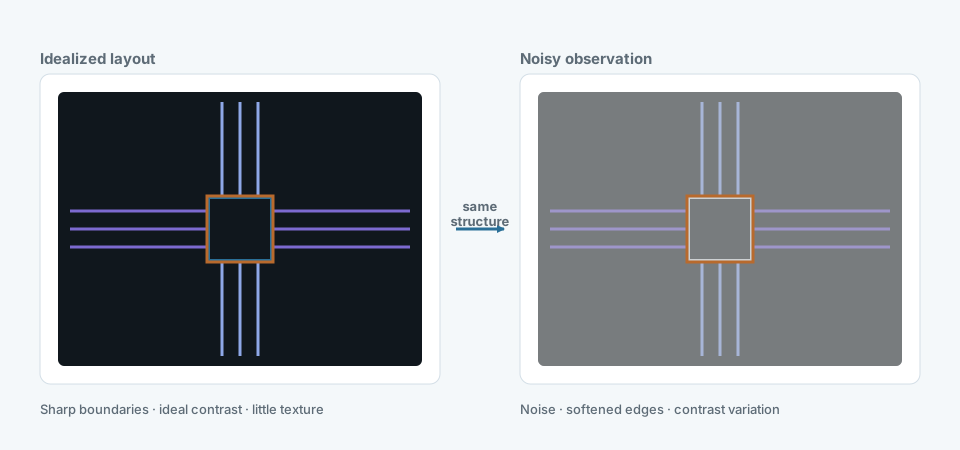
A layout says where geometry should be. An observation also contains blur, texture, contrast variation, and measurement noise.
Pixel correspondence is not obvious across these domains. Clean boundaries become soft transitions; uniform regions acquire texture; nominal geometry can differ from its observed shape. A comparison method that expects the two images to look alike must first account for that visual gap.
The harder issue begins before training. Paired supervision assumes that a source pixel and a target pixel refer to the same place. Residual translation error makes a correct edge look wrong to a reconstruction loss. The documented workflow therefore treats alignment and pair quality as model inputs, not clerical preprocessing.
The Approach: Conditional Image Translation
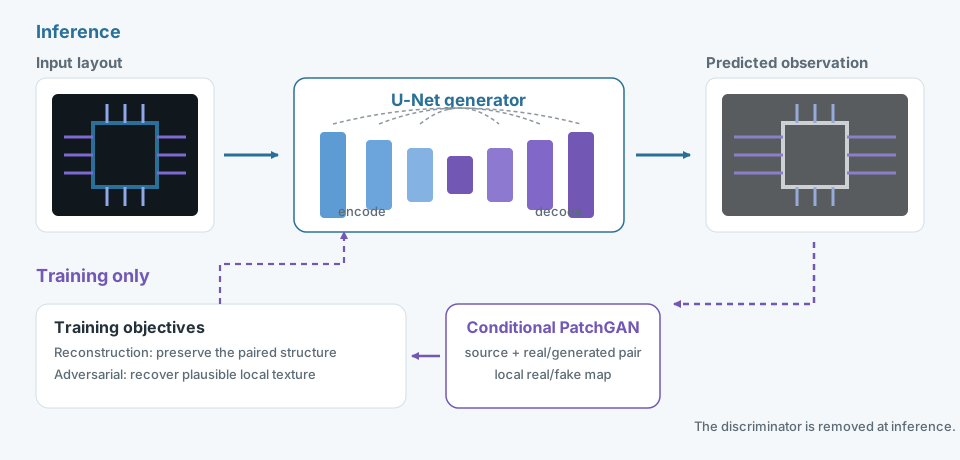
The generator is the inference path. The discriminator is a training signal that judges local output patches in the context of the source.
The implemented design uses a U-Net generator. Its bottleneck carries broad context; skip connections return high-resolution location information to the decoder so exact edge positions do not have to be rebuilt from a compressed representation alone.
A conditional PatchGAN sees the source together with either a real or generated target. Its spatial output asks whether local edge and texture patches are plausible for that particular source, rather than assigning one score to the whole image.
The objectives pull in different directions:
- Reconstruction loss anchors the output to its paired target. It protects correspondence but tends toward smooth averages.
- Adversarial loss pushes local texture and boundaries toward the observation domain. Used alone, it can reward an image that looks plausible but changes the structure.
- Cycle consistency was used in the documented bidirectional setup to discourage either direction from discarding information needed to reconstruct its input.
The engineering priority is structural fidelity first and realism second. A convincing output with a moved or invented feature is a failure for matching.
Engineering the Training Pipeline
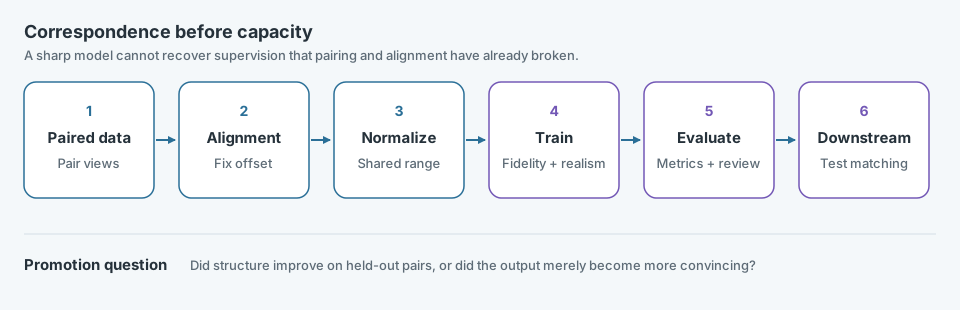
A larger network cannot repair supervision that was already broken by a bad pair.
The implemented workflow reflects that ordering:
- Prepare paired views. Each geometric input must correspond to one observation of the same structure.
- Align before cropping. Correlation-based alignment places the pair on a shared frame; weak agreements are quality-control cases, not pairs to force through training.
- Apply paired transforms. Safe geometric augmentation is applied identically to both images. Photometric augmentation is avoided when intensity itself carries meaning.
- Normalize consistently. Inputs and targets share the range expected by the generator output, keeping training and inference preprocessing identical.
- Train from a stable baseline. The documented experiments progressed from a U-Net/PatchGAN baseline to least-squares adversarial loss, discriminator regularization, softened real labels, and a buffer of recent generated samples when discriminator dominance destabilized training.
- Evaluate structure, not only appearance. Pixel, structural-similarity, signal-quality, and overlap measures answer different questions; visual overlays and edge checks reveal local errors those summaries can hide.
The important experiment was not “add a larger model.” It was to stabilize a known architecture, verify the data path, and only then explore low-resolution attention and feature matching as targeted extensions.
Experiments & Illustrative Comparisons
The reference articles document the training behavior, objectives, and evaluation method, but this public page does not include approved experimental image pairs. The comparisons below are synthetic prompts for evaluation. They are not model results.
1 Repetitive lines
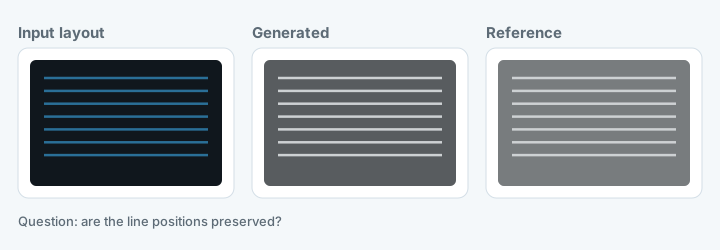
Repeated texture can look convincing while hiding a missing or invented line. Count and position matter more than visual smoothness.
2 Repeated contacts
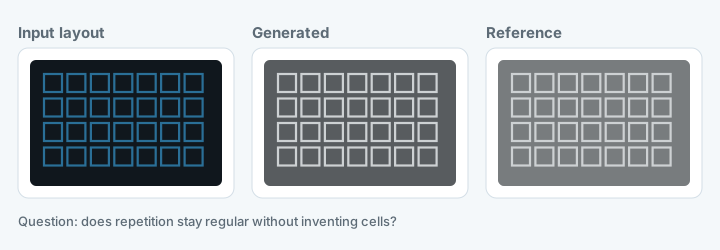
A local discriminator rewards plausible cells. Evaluation must still verify that the array has not gained, lost, or shifted one.
3 Intersecting structure
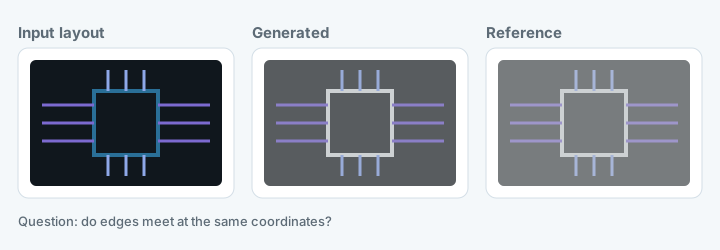
Skip connections help preserve where edges meet; texture quality does not prove that the intersection stayed at the correct coordinates.
4 Uncommon geometry
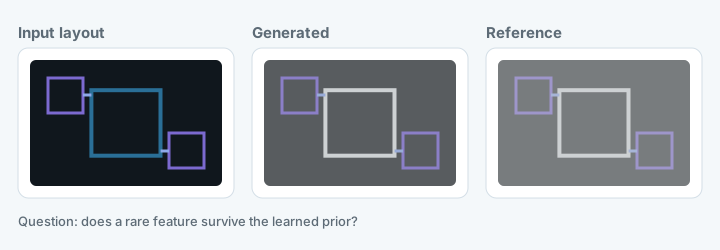
A strong learned prior can “correct” an unusual feature toward a familiar one. Rare structures test whether the model follows the input.
What Makes This Difficult?
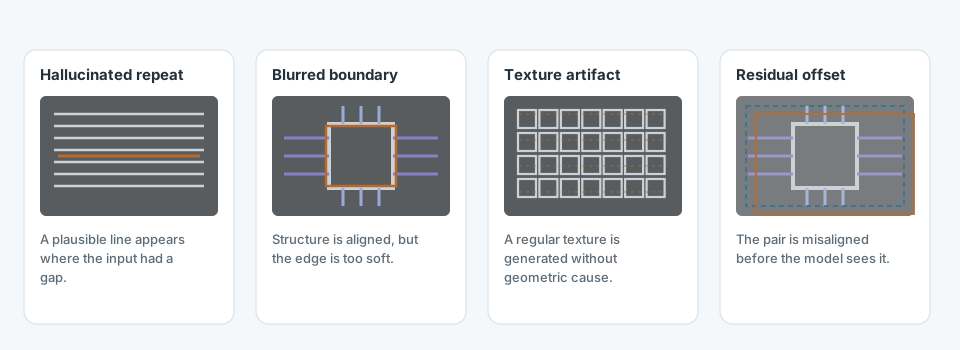
Each failure asks for a different response: stronger structural anchoring, a better realism signal, architecture changes, or repair of the data pair.
Domain gap
The model must change image statistics without changing which structure the image describes. The greater the visual gap, the easier it is to mistake realism for correspondence.
Structural fidelity
Reconstruction supervision protects position but can blur uncertain detail. Adversarial pressure sharpens detail but can invent a pattern that the discriminator finds familiar.
Training stability
Generator and discriminator learn against moving targets. The documented baseline failed when the discriminator became confident too early; smoother losses and constrained discriminator behavior restored a useful learning signal.
Generalization
Familiar patterns do not prove behavior on rare geometry. Evaluation needs held-out structures and cohorts, not only an average over examples that resemble training.
Engineering Insights
Data quality sets the ceiling
When paired pixels describe different locations, the loss teaches blur. Alignment and pair inspection deserve attention before architecture search.
Correctness needs more than realism
A discriminator can say that an image belongs to the target domain. It cannot, by itself, prove that the output belongs to this input. Paired reconstruction and cycle constraints supply that connection.
Metrics are screening tools
Pixel error, structural similarity, signal-quality measures, and overlap each miss something. Edge placement and expert review remain necessary when one misplaced feature can invalidate an otherwise strong score.
Matching remains a hypothesis
A translated image may reduce visual-domain mismatch, but realism alone does not establish better registration. Downstream matching must be evaluated separately before claiming an improvement.
The next step is not automatic deployment. It is a controlled downstream study: compare matching behavior on held-out pairs, inspect structural failures by pattern type, and decide whether translation adds information or merely changes appearance.