All figures on this page are conceptual illustrations built from synthetic geometry. None of them shows measured data, real layouts, or benchmark results.
The Challenge
A reliable registration location is not a window that merely resembles a template. In a large geometric layout, the same cells, lines, and spacings recur. A local match can look convincing and still be one of many interchangeable positions.
Three effects make a score-only, exhaustive search fail:
- Repetition produces several plausible correspondences, often close together. The strongest local score can land on the wrong copy.
- Rasterization can soften the small geometric break that made one window distinctive, so the cue that would separate the copies is easy to lose.
- Scale makes the same expensive test at every coordinate wasteful, while pruning too aggressively can skip the rare locations that are actually useful.
The design has to search selectively, then accept a correspondence only when it is unique enough to trust.
Search Space Visualization
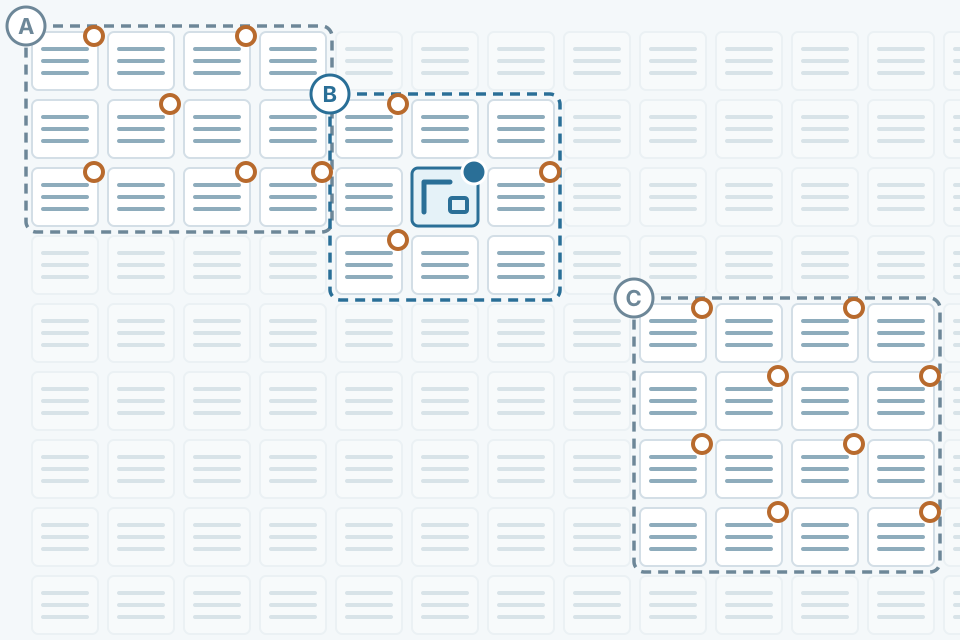
- Repeating cell
- Distinctive cell
- Search region
- Not searched
- Ambiguous candidate
- Distinctive candidate
Most candidates are interchangeable. In a repetitive layout, almost every proposed location looks like its neighbors, and only one sits on geometry that does not repeat.
Search is limited to regions A, B, and C because testing every coordinate does not scale. That choice has a cost: a distinctive cell outside every region is never proposed, so where the regions sit is part of the algorithm. Constraint alone is also not enough. Regions A and C still repeat, and only B contains the geometric break.
Robust Matching
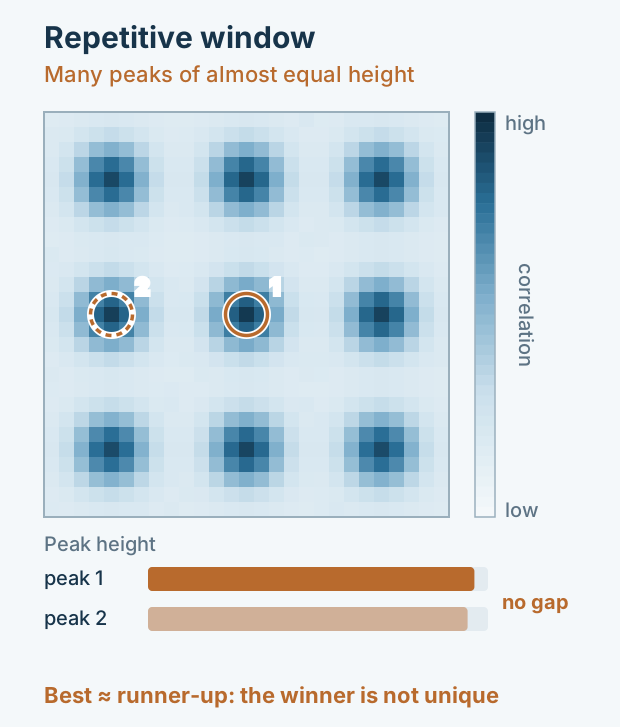
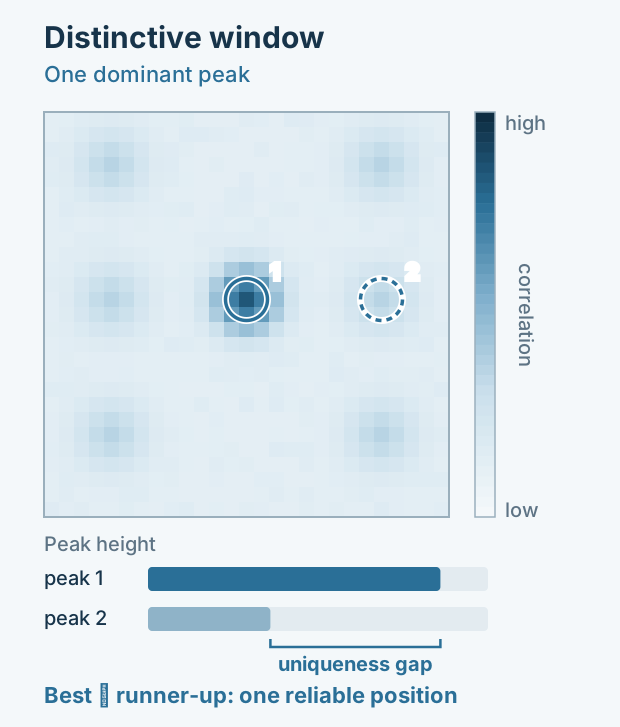
The higher maximum is the less reliable match. Both maps share one color scale. The repetitive window on the left reaches the higher peak, but its runner-up is almost as strong.
Normalized cross-correlation scores how well the template agrees with the window at each offset. It does not say whether that agreement is unique, which is the question repetition makes urgent.
Peak uniqueness compares the best peak with the strongest competitor outside its neighborhood. On the left, the winning peak is higher, but the gap is small enough that noise or a slight edge change can move the offset onto a neighboring copy. On the right, the peak is lower and the gap is decisive. Ranking uses uniqueness together with correlation strength and Sobel edge support, so a repeated high score cannot outrank a stable one. Sobel support is there because a match should be carried by structural boundaries, not by a smooth region that many cells share.
System Architecture
1 Hierarchical layout
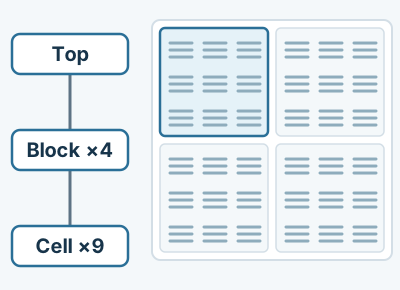
Each cell is defined once and placed by reference many times. Flattening the whole layout up front would multiply every repeated cell.
2 Spatial window extraction
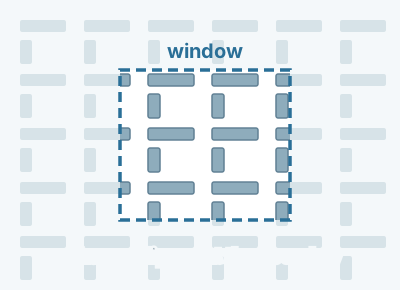
Only instances that overlap the window are expanded, and their shapes are clipped at the window boundary.
3 Polygon operations
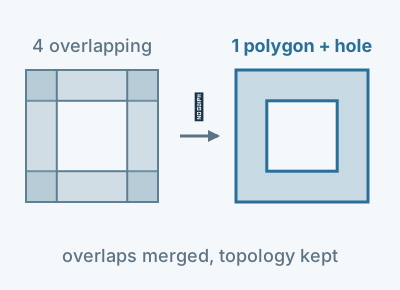
A polygon union merges overlapping shapes into clean outlines and keeps holes explicit before any pixel exists.
4 Rasterization
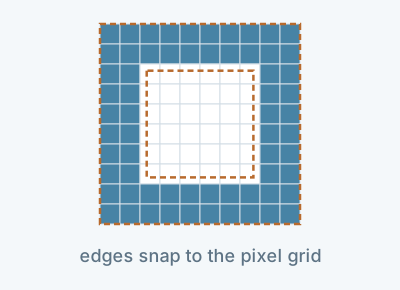
The polygons are sampled onto a pixel grid. Edges snap to pixel boundaries, so resolution sets how much geometric detail survives.
Geometry is resolved in vector space and only then converted to pixels. Work is limited to one window at a time, and topology is fixed before rasterization.
That bound is what makes the later search selective. Geometry is paid for only where a region will actually be tested, so a larger field does not require a larger matcher.
- 1
Geometric Layout
Keep repetition as placed instances, so the field does not have to be copied before a window is known.
- 2
Windowed Geometry Processing
Expand, clean, and rasterize only the geometry one search window needs.
- 3
Candidate Generation
Propose locations inside spatial constraints instead of every coordinate.
- 4
Template Matching
Score those candidates by how their structural edges agree with the template.
- 5
Quality Evaluation & Ranking
Prefer a unique, well-supported peak over the highest score.
- 6
Selected Registration Locations
Keep stable correspondences, and stop once enough of them are accepted.
Engineering Trade-offs
Adaptive stopping on a ranked candidate list
- 1
- 2
- 3
- 4
- 5
- 6
- 7
- 8
- 9
- 10
- 11
- 12
- Accepted: unique, well-supported peak
- Rejected: ambiguous peak
- Never evaluated
Most of the search work is never performed. Bar widths and candidate counts show the shape of the reduction, not measured savings.
Each cut in the funnel saves work only if the locations it drops were not the ones worth trusting.
Search quality
A high score on a repeated pattern can move when the window changes slightly. Rejecting peaks that are not clearly separated avoids correspondences that would not stay put.
Computational cost
Comparing competing peaks and checking edge support costs more than taking the first maximum. That extra work is what makes an ambiguous high score visible.
Candidate coverage
Constraints and early filters shrink the search. Drawn too tightly, they remove the uncommon neighborhood that breaks the repeat before it is scored.
Execution efficiency
Stopping early is safe only because unique peaks are ranked first and the stop rule counts accepted locations, not high scores. Otherwise the search can halt on a repeated maximum.
Engineering Outcomes
These are capabilities of the design, not measured benchmark results.
Reliable correspondence
A selected location can hold in a repeated pattern because acceptance depends on uniqueness, not on which copy scored highest.
Selective large-scale search
Most of the layout is never fully compared. The expensive test is reserved for candidates that already survived a spatial and structural filter.
Robustness from structure
Matches stay anchored to geometry that repetition does not erase. A change in pixel resolution does not silently rewrite which shapes exist.
An adjustable workflow
Coverage, ranking, and stopping can be tightened or relaxed on their own. The balance between reliability and cost does not require replacing the matcher.